
“I Meant To” – Words I Never Want to Say or Hear Again
Sometimes something happens that sticks with you long after, and changes how you think forever.
This one hit me in late 2020 and early 2021.
My uncle, who lived in another town, called me three days before Christmas to say he’d been given four weeks to live.
Sometimes something happens that sticks with you long after, and changes how you think forever.
This one hit me in late 2020 and early 2021.
My uncle, who lived in another town, called me three days before Christmas to say he’d been given four weeks to live. That was a hell of a blow. I flew up to see him, spoke with the doctors, and we made a plan. He had a blood clot that had cut off the blood flow to his lower body, made worse by years in a wheelchair. There was nothing more they could do.
I spent time with him, came home for Christmas, went back up, came home for New Year’s, then headed up again in early January once he was out of hospital. I helped clear out his house and looked after him as he prepared to die.
He was a hoarder of car parts, so I did a lot of heavy lifting — throwing metal into three massive skips.
During that month, I’d come across interesting items from his life. We’d talk about them and reminisce, which was nice. But more than a few times I’d find something cool — like the detailed plans for a lift jig that would let him get back into truck driving from his wheelchair. When I asked about it, he’d say, “Yeah, I meant to do something about that…” but never did, because it would have been difficult.
That phrase came up multiple times.
He passed away late January (the stubborn bugger made it six weeks, not four). Once I’d sorted the estate, those words really hit me. He was an amazing man who did a lot of good things, and I cherish his memory. But he had let his difficulties get in the way of opportunities he wanted to chase.
I can’t imagine what it’s like to roll a truck, break your back, and end up in a wheelchair. But I know plenty of people have achieved a lot from even tougher starting points.
So I made a quiet resolution: I never want to look back and say “I meant to.” I will either do it, or consciously decide not to. Life is full of trade-offs. Choosing to do one thing means choosing not to do something else — and that’s fine. But doing nothing and hiding behind “I meant to” is still a decision.
This is easier said than done, of course. That’s why I have coaches and systems in place to turn this into routine, not just hope.
What’s holding you back from the things you want to do? What have you been telling yourself you “meant to” do?
I’ve got a lot on my plate, and I’m behind on some of my own goals and mission. But if I fail, it won’t be because I “meant to…”
Take What Works – Leave the Rest Behind
Years ago I was at an NZMBA conference (the New Zealand Mortgage Brokers Association — that tells you how long ago it was). The main speaker was “the Beechworth baker,” Tom O’Toole. He had a very different style to the usual conference speaker — almost Billy Connollyesque. I reckon he knew not everyone would warm to it.
Years ago I was at an NZMBA conference (the New Zealand Mortgage Brokers Association — that tells you how long ago it was). The main speaker was “the Beechworth baker,” Tom O’Toole. He had a very different style to the usual conference speaker — almost Billy Connollyesque. I reckon he knew not everyone would warm to it.
But what he said in the first few minutes has stuck with me ever since, even though I can barely remember anything else from the talk (except a few bakery stories that aren’t exactly business gold).
He said: “Take what works, leave the rest behind.” In other words, grab the bits from my talk that are useful to you, and ignore the rest.
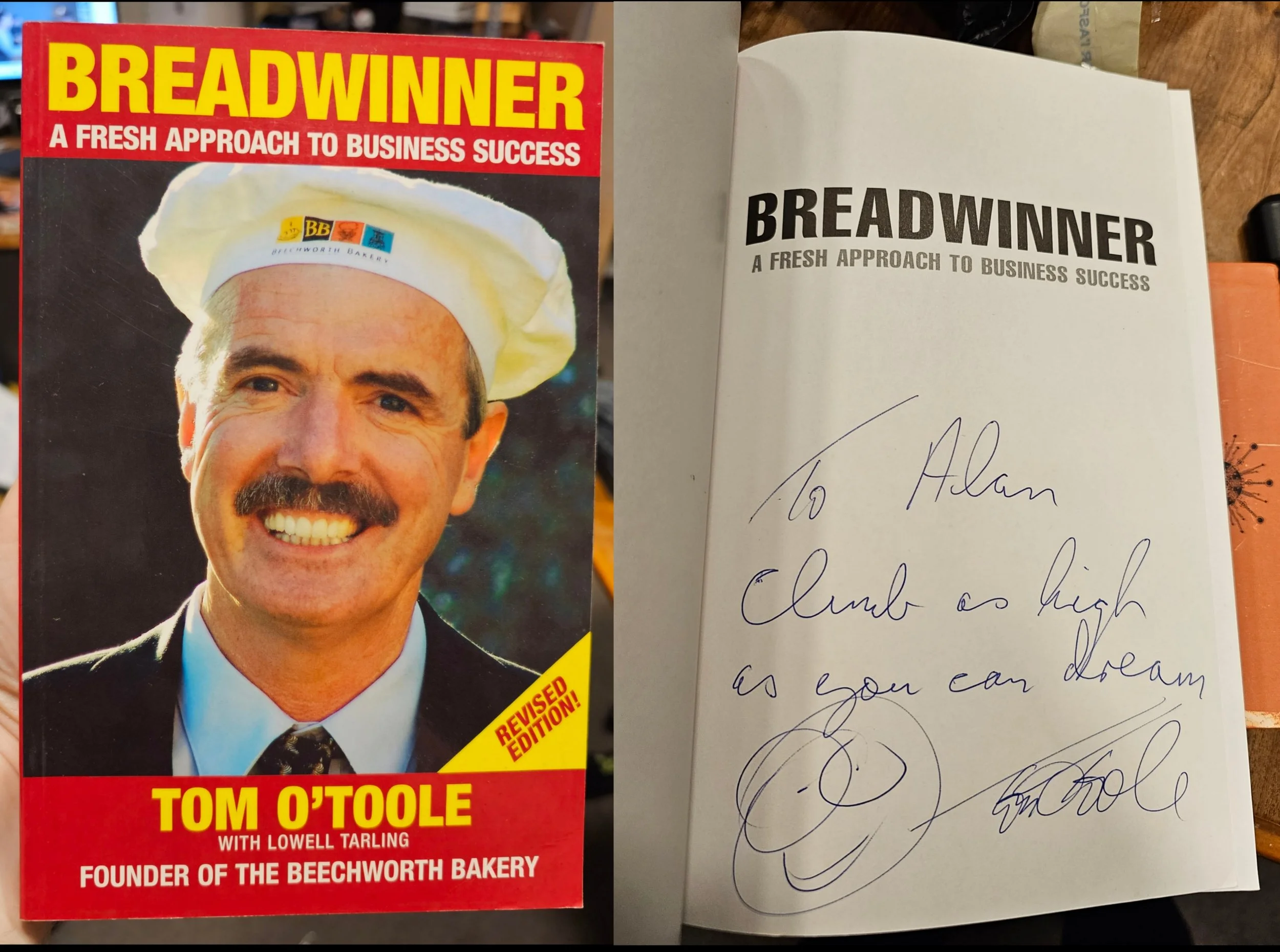
I also bought his book at the conference and he signed it. i need to reread this.
Why did that line stick? At first it just felt like a refreshing quote. Most speakers seem to want you to hang on every word and swallow their ideas whole. But Tom was giving permission upfront — if you get one useful thing, use it. If you hate everything else, that’s fine too.
That simple idea has shaped how I approach conferences, learning, and advice ever since. When I go to an event now, I’m not expecting wall-to-wall brilliance. I’m just hunting for one or two good ideas — or even part of an idea I can adapt and make my own. The rest? Irrelevant. I happily duck out when a politician starts speaking or some local proto-celebrity takes the stage.
I’ve spoken to other advisers who say they don’t bother with conferences anymore because “it’s a waste of time.” They go in expecting non-stop motivation or pure value, then feel let down. One bloke even got a bit miffy at me for leaving a conference at lunchtime. The morning had been excellent, but the afternoon looked pretty meh, so I headed off to sit somewhere quiet and think about the bits I liked.
I apply the same mindset to coaches and mentors I work with. I don’t always agree with everything they say. But I don’t burn the relationship over one disagreement. I take what works for me, leave the rest behind, and keep going. Often their contrarian view actually strengthens my own thinking. I don’t need yes-men.
I use exactly the same approach with my clients.
We advisers sometimes want to be the single font of all knowledge, with our perfect 27-step process that clients “should” follow. But people don’t always want that. They like doing things their own way.
I’ve got what I think is a frankly amazing budgeting system. Thousands of people have been through it over the years, and plenty still want to tweak it or do bits their own way. I could dig my heels in and demand they follow it to the letter. But it’s much easier (and smarter) to say: “Take the bits that work for you, leave the rest behind. If the hybrid version works, great — the system is still a success.”
I always add one caveat though: “If you find it’s not working doing it your way with bits of my system, are you okay with us going back and looking at using the whole thing properly?” You usually get easy agreement on that.
Rather than fighting clients, you let them lead a bit, make their own mistakes, and discover what actually fits them.
So have a think about how you approach learning and taking advice yourself — and how you give advice to your clients.
If you want some help with your business, give me a buzz. I’m here for it. And of course, if you don’t like what you’ve read here… take what works, leave the rest behind.
One Thing I See a Lot: Worrying About Stuff That Doesn’t Matter
It’s very common to see advisers (and plenty of others) getting worked up about what some minor functionary in a distant land is doing, or what some celebrity is saying about this or that. It’s all noise designed to keep us distracted and mostly angry. The media knows angry and scared people are more likely to keep listening. Social media works exactly the same way — the algorithm feeds you more of what keeps you hooked, and negativity does that better than positivity.
So how do we cut through all the crap and focus on what we should actually be doing — like building our businesses?
One thing I see a lot out there is people worrying about stuff that doesn’t matter.
It’s very common to see advisers (and plenty of others) getting worked up about what some minor functionary in a distant land is doing, or what some celebrity is saying about this or that. It’s all noise designed to keep us distracted and mostly angry. The media knows angry and scared people are more likely to keep listening. Social media works exactly the same way — the algorithm feeds you more of what keeps you hooked, and negativity does that better than positivity.
So how do we cut through all the crap and focus on what we should actually be doing — like building our businesses?
This is just one part of a series of key things I’ll be covering in coming articles.
Firstly, get off or seriously reduce your exposure to the media. I don’t read or watch the news, and yet somehow the important stuff still gets through to me anyway. Some people I know ask Grok or another AI to give them a neutral daily summary, but I don’t even bother with that. Do the same with social media — cull the accounts that just pump out negative stuff and focus on what’s useful or good.
That’s the easier part. Now for the harder bit: changing how we think.
We need to shrink the areas we spend mental energy on.
Stephen R. Covey explains this brilliantly in The 7 Habits of Highly Effective People with his three circles:
Circle of Concern: All the things you care about or worry about (global events, other people’s behaviour, the economy, the weather, politics, etc.).
Circle of Influence: The smaller slice where you can actually make a difference through your actions, choices, or indirect impact.
Circle of Control: The smallest circle — the things you have direct personal control over, like your own attitudes, responses, habits, and daily decisions.
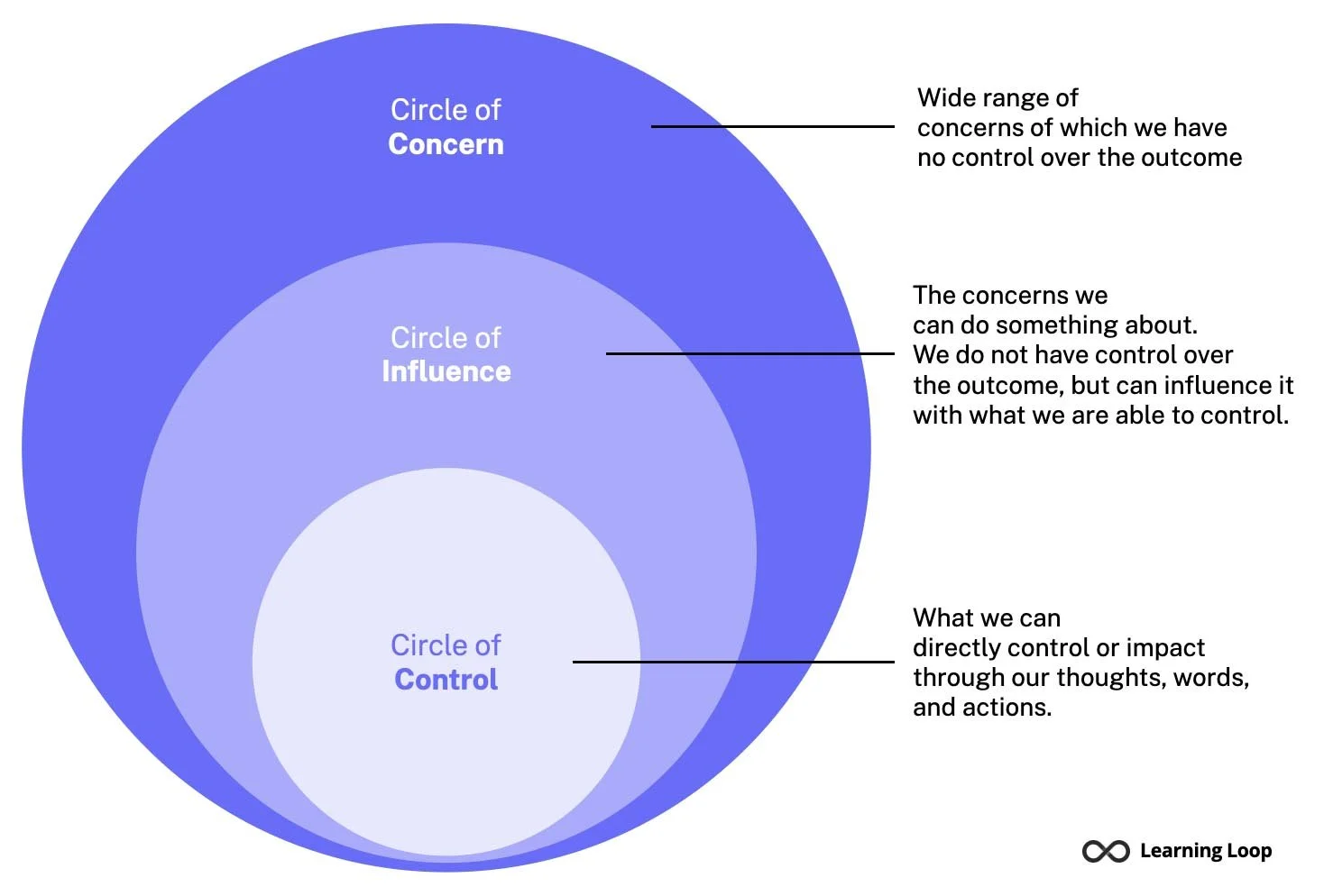
Circles of Concern, Influence and Control - Credit to Learning Loop.
Too many people today have a massive Circle of Concern, blown up by 24-hour news and social media. The result? Constant stress and anxiety, because you can’t do anything about most of it.
The key is to deliberately shrink your Circle of Concern so it’s barely bigger than your Circle of Influence. You do this by ignoring — and simply not engaging with — the things you cannot influence.
This doesn’t mean you can’t enjoy things outside your control. For example, I’m a keen UFC fan, so the result of a title fight sits in my Circle of Concern. But I have zero influence or control over it. I watch the fight, then I move on. There’s nothing sadder than a grown adult staying angry for days over a sports result.
Stoicism helps a lot here. In my family, I’m teaching the kids to simply say “oh well” when something outside our control or influence goes against us.
By reducing your Circle of Concern, you free up way more energy to focus on what you can influence and control. That’s where real productivity and progress come from.
Have a look at your own life right now. How big is your Circle of Concern? And what are you actively doing to shrink it?
What changes I made (and why), while keeping your exact v
Abundance vs Scarcity
It’s very tempting to keep what you know to yourself so others can’t “steal” it or copy it. I’m even seeing some advisers running ads claiming others are stealing their ideas—only to realise it’s something I first saw and used twenty years ago. Good marketing, but not exactly groundbreaking.

Photo credit Rob Commodari--Seeing the world from a place of abundance
I can tell some potential coaching clients get a bit nervous about working with an existing adviser (a competitor) because coaching means the coach has to know their business inside out. They worry I might take their ideas and use them in my own business. And honestly? They’re right—I do get inspired by my clients and I do apply what I learn to my own stuff.
But here’s the flip side: I’m also giving away a lot of my own ideas in the process.
With an abundance mentality, my theory is simple—we both walk away better off. We’ll each do things slightly differently, so there’s no real competition anyway.
With a scarcity mentality, you keep everything close to your chest so no one knows your ideas. The problem? You don’t grow unless you figure it all out on your own.
This mindset shows up everywhere in business. Do you spend a bit of money and accept you might not get every dollar back, or do you penny-pinch every little thing, save a few bucks, but waste hours (or weeks) of your time?
I’ve seen good advisers doing their own accounting coding and monthly wash-ups just to save on the accountant’s fee—only to spend hours they could have used seeing clients.
I’ve seen advisers spend a whole year’s worth of effort trying to cut a $100-a-month bill.
It’s not that efficiencies are bad or that you should never look for savings. But when you come at everything purely to spend less, your focus stays tiny.
Scarcity mentality wants a detailed contract covering every possible facet. Abundance works on trust and clarity. Sure, you can get burned more often with abundance, but if you’re focused on building everyone up instead of covering every conceivable risk, you end up way better off.
I see both types in the adviser world all the time. The abundance people get let down and disappointed more often, no question. But they also end up multiples better off than the ones who never took a chance because they were too busy focusing on the “what ifs” and purely the costs.
With an abundance mentality you’ll give away free advice that may never get reciprocated. But you’ll also pick up clients you never expected—because they heard from a guy who heard from a girl who loved one of your giveaways.
If you want to build a long-term, deeper, more fulfilling business, focus on abundance and growth—not just reducing costs and risks. Long term, I reckon you’ll be happier and do better.